Stochastic Screening vs Halftone: When Random Dots Beat a Rosette
AM halftone changes dot size on an angled grid; FM stochastic screening keeps dots one size and changes their density. What that removes, and what it costs.
01/ ARTICLE
 subject: snow leopard · look: blue-noise · threshold 0.50 · 1px · Image made with kott.io
What is the difference between stochastic screening and halftone?
Conventional halftone is AM, amplitude modulated, screening: dots sit on a fixed, angled grid and get bigger or smaller to carry tone. Stochastic screening is FM, frequency modulated, screening: every dot is the same small size, and tone comes from how many dots you place in an area. FM removes the screen-angle decision, and with it the rosette, in exchange for dots so small that your plates and press room have to hold them.
Stochastic screening is a halftone method that places same-size dots pseudo-randomly and varies their density, instead of varying dot size on a regular grid.
What is stochastic (FM) screening?
Wikipedia describes FM screening as a halftone process based on a pseudo-random distribution of dots. It gives AM dot sizes of 10 to 200 micrometres, and an FM dot of about 25 micrometres as an example of a fixed size. The Print Guide puts a common FM reference at 20 to 25 microns, roughly comparable to a 200 lpi AM screen.
The same logic shows up in digital dithering. If you've seen the blue-noise look, you've seen the idea: constant dot size, irregular but evenly spread placement. A blue-noise dither in kott® is a decent on-screen stand-in for what an FM screen does on a plate, though a real FM screen comes from your RIP, built for your plate resolution.
Why does FM screening get rid of rosettes and moire?
A four-colour AM job needs four screens at four angles so the grids don't clash. Where they overlap you get a rosette, and when the angles or registration are off you get moire. Wikipedia notes that FM no longer uses four different angles, so screening moire is eliminated and no rosette pattern forms. If you've fought this on press, the angles and mesh counts that prevent moire in screen printing cover the AM-side fix. The same logic carries over to riso colour separation where each ink layer needs its own angle.
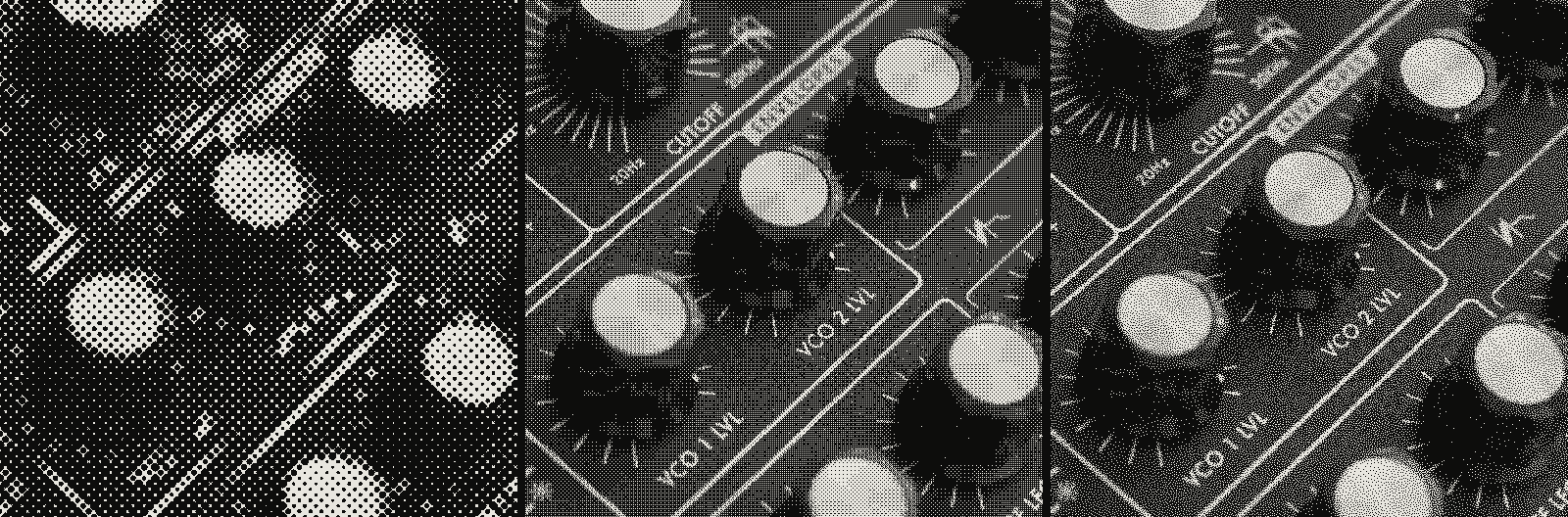 subject: synth knobs · look: halftone / bayer / blue-noise · reading order: halftone cell 8px angle 0° shape circle / bayer 4x4 matrix threshold 0.50 1px / blue-noise threshold 0.50 1px · Image made with kott.io
Misregistration is where FM earns its keep. The Print Guide says an AM rosette can shift from a fine 175 lpi look to a coarse 85 lpi look when registration drifts. An FM screen has no such structure to fall apart, so it degrades gently. Wikipedia is careful here: misregistration effects are less apparent, not eliminated.
| AM halftone | FM stochastic | |
|---|---|---|
| What varies | Dot size | Dot density |
| Dot size | Large to small across the tone range (10 to 200 micrometres cited) | Fixed and small (about 20 to 25 micrometres cited) |
| Screen angles | Required, one per ink | None |
| Rosette and screening moire | Possible if angles or registration drift | Not created |
| Flat tints | Smooth, easy to hold | Can look grainy with first-order screens or low plate resolution |
| Process control | Forgiving | Tighter, cleaner environment |
| Typical call | Coarse output, flexo, loose control | Fine plates, registration drift, rosette trouble |
The grid in this article puts the same snow leopard through an angled halftone, a Bayer pattern and blue-noise dots, rendered by kott. Notice that the angled grid draws a visible lattice, while the blue-noise cell has no direction at all.
What does FM screening cost you?
Small dots are the whole trade. Wikipedia lists the main drawback as the special care and cleanliness the small dots require, especially when plates are made from film. The Print Guide adds a longer list of risks:
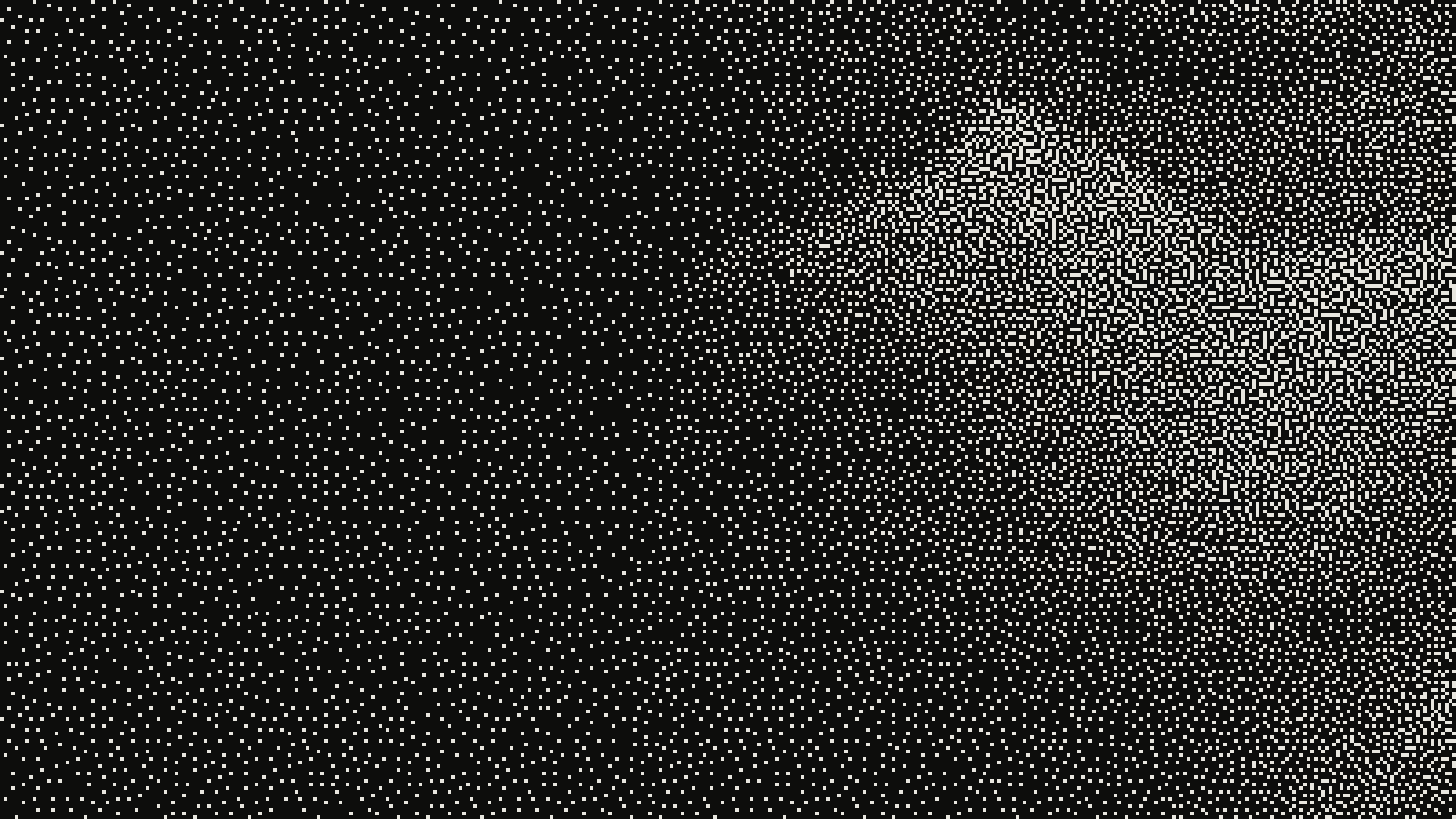 subject: greek statue · look: blue-noise · threshold 0.50 · 1px · centre crop enlarged 4x, nearest-neighbour · Image made with kott.io
- Graininess in flat tints. Usually from first-order screen designs, inadequate plate resolution, or spot colours with coarse pigment grind. Modern second-order FM screens reduce it.
- Colour matching. The wider gamut can make one- and two-colour tints look more vibrant and complicate matching to standards such as SWOP or GRACoL.
- Detail exposure. Higher screen frequencies show more flaws in the original, and resampled images can come out soft.
- Process control. Smaller dots need tighter control, and the guide says failures often trace to weak control, no operator buy-in, or using FM only on occasional jobs.
Plate-making matters too. Wikipedia ties the revival of FM to computer-to-plate, and notes a tone reproduction compensation curve is typically applied to match targets such as ISO 12647-2. Zoom a fine FM render in to 100% and you'll see why: at close range fixed-size dots read as grain, and any dust on the proof shows as a mark. Plan for that failure mode. It's a cost of the method, not a defect in it.
Does FM screening work on web presses?
Yes. A common claim is that FM dots are too small for roll-fed web presses. The sources point the other way. Wikipedia calls FM favourable for rotary machines because misregistration from effects like web growth is common there. The Print Guide cites a newspaper press that uses FM exclusively, an older press running week-long cereal box jobs with FM, and reports that about 80% of North American directory printing uses it.
Web presses do have their own FM risk. The Print Guide names piling, mostly on heatset web presses, typically from poor blanket washup or ink formulated for AM dots. It is rare on sheetfed presses. The same source says the press itself doesn't distinguish AM from FM; problems trace to dot size, not arrangement.
Flexo is the exception worth knowing. The guide's author said in a comment that no vendor had commercialized FM for flexo as of 2014, and that hybrid AM screens were popular with flexo printers. Ask your vendor what's on offer today before you assume either way.
Does FM screening really save ink?
Sometimes, and by a modest amount that depends on the job. The Print Guide gives roughly 10 to 15% less ink, depending on tone content. Brumley Printing claims up to 10%, but that's one commercial printer's marketing copy and its comparison is loosely worded, so treat it as a ceiling, not a promise.
The gamut claim has a mechanism behind it: more dots for the same tone means more light is filtered by the ink and less reflects off the substrate, which Wikipedia says gives a greater gamut than conventional AM screens.
When should you stay with AM screening?
Stay with AM when your output can't resolve a 20 to 25 micron dot, when your press room can't hold the cleanliness and control FM demands, or when your process is flexo and your vendor offers only hybrid AM. Pick FM when rosettes or registration drift are your recurring problem and your plates resolve the dot. If you're sending artwork to a large-format shop, the same principle applies: 1-bit artwork at large format breaks when the dot structure can't survive the output, whichever screening you choose.
To see how a fixed-size dot pattern behaves on your own image before you commit, try blue-noise and halftone side by side in the kott studio.
Frequently Asked Questions
Is stochastic screening the same as FM screening?
Yes. Stochastic and FM (frequency modulated) screening both mean a halftone built from same-size dots placed pseudo-randomly, with density carrying the tone.
Does stochastic screening remove moire completely?
It removes screen-angle moire and rosettes because there are no screen angles to clash. Misregistration is made less visible, not eliminated.
Can I use FM screening on a riso or screen-print job?
Only if your output can hold the dot. Fine FM dots need plate or stencil resolution to match, so check what your process resolves before committing.
Images in this article were made with kott.io.
02/ OUT
Every setting described above is a real control. Open your own image and sweep it.
All journal entries