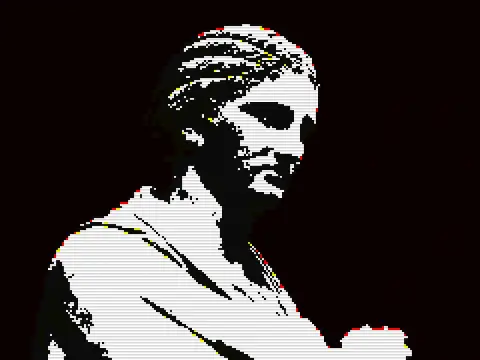
e-ink effect

 SourceEffect
01/ ORIGIN
Electrophoretic displays came out of MIT Media Lab research in the 1990s and reached consumers when E Ink's screens shipped in the first e-readers of the following decade. They hold an image with no power at all, because charged pigment particles physically move and then stay where they were put. That is also the source of their defining flaw: clearing the previous image is mechanical, imperfect, and slow, which is why a faint ghost of the last page persists.
02/ SWEEP
PIXEL sweep



03/ SPEC
This effect reproduces an electrophoretic panel: a hard tonal reduction toward black and white with a faint retained image beneath it. GHOSTING runs from 0 to 0.8 with a default of 0.22 and sets how much of the previous frame remains visible, which is the artifact that distinguishes e-ink from any other one-bit reduction. REFRESH from 1 to 20 seconds controls how often the panel fully clears, so it only matters on moving sources. PIXEL scales the particle grid from 1 to 8 pixels, and THRESHOLD is an advanced balance control. In kott the ghost is composited per pixel rather than as an overlay.
04/ FAQ
- What is an e-ink effect?
- An e-ink effect imitates an electrophoretic display: a hard black and white reduction with a faint ghost of the previously shown image retained underneath it.
- Why do e-ink screens show ghosting?
- An electrophoretic panel holds its image by physically moving charged pigment particles, and clearing them is mechanical and imperfect. Some particles stay put, leaving a faint residue of the last page.
- Does GHOSTING do anything on a still image?
- Yes, but less than on video. On a still it blends a slightly offset copy of the same frame, which reads as softening. On moving footage it retains genuinely different previous content.